
Bengaluru, by the numbers: the one city where the area you pick barely matters
In most Indian cities, choosing the area is already choosing your options. Pick the famous address in Gurugram and you are shopping in a locality that returned 15 workspaces while the road beside it returned 56. Pick Nariman Point in Mumbai and you get 10. Pick Manesar and you get one.
We counted Bengaluru expecting the same shape. It is not there.
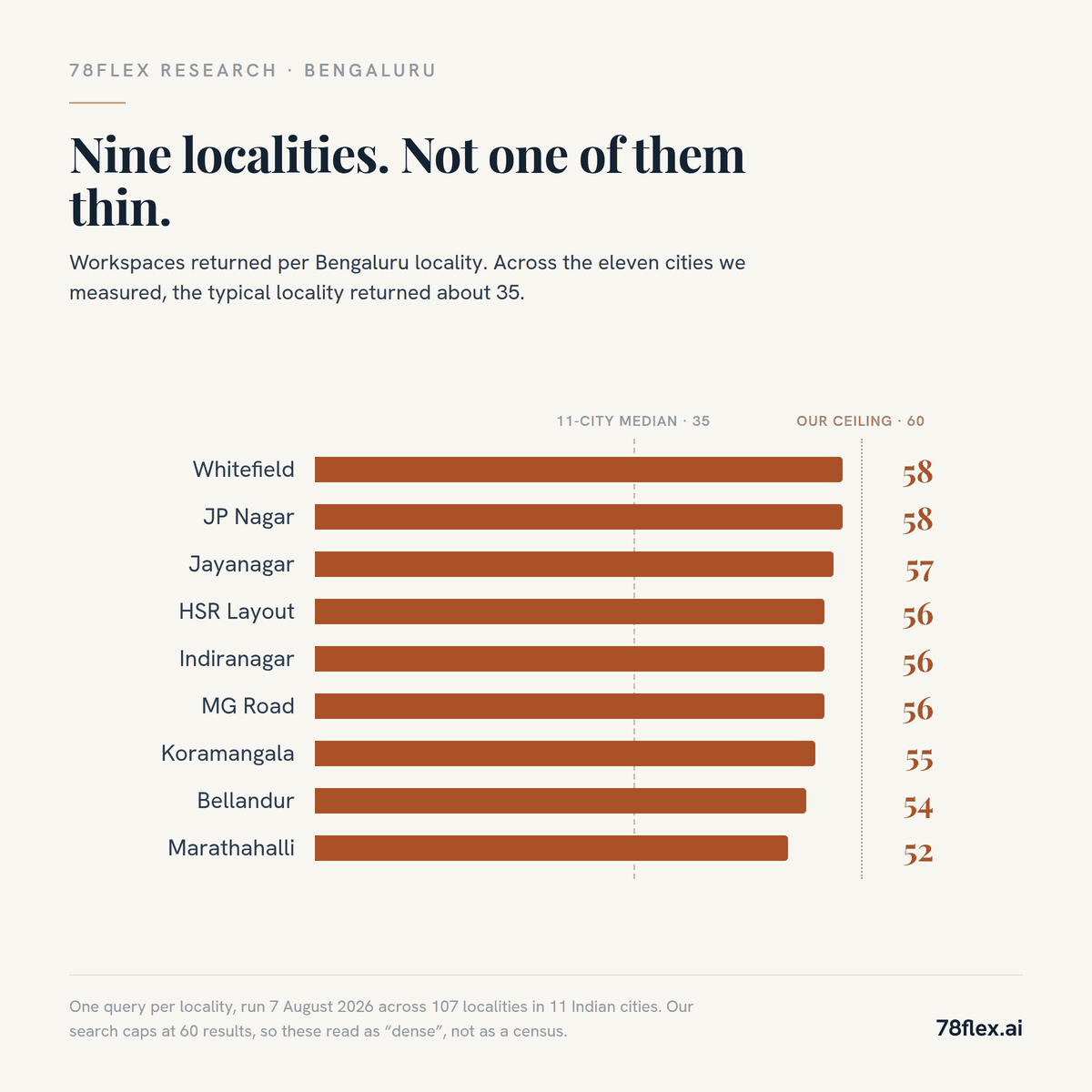
The nine numbers
One search per locality, run on 7 August 2026, counting distinct workspace results.
- Whitefield — 58
- JP Nagar — 58
- Jayanagar — 57
- HSR Layout — 56
- Indiranagar — 56
- MG Road — 56
- Koramangala — 55
- Bellandur — 54
- Marathahalli — 52
Read the spread, not the order
Before anything else: that list is not a ranking, and we would rather say so than let you treat it as one.
Our search returns a maximum of 60 results. Every number above sits within eight of that ceiling. When a measurement is pressed up against its own limit, the differences between the readings stop meaning much — Whitefield at 58 and Koramangala at 55 are not three workspaces apart in any way you could act on, and both may have considerably more than we recorded. What the numbers can carry is the shape: nine localities, all dense, none thin.
Why that is unusual
Across the eleven cities we measured, the typical locality returned about 35 workspaces. Most cities have two or three deep areas and a long tail of thin ones, and the thin ones are easy to walk into because they are often the ones with the reputation.
The comparison worth making is like for like. In every city we drew up our own list of the localities that matter — the places a team would actually consider. In Gurugram that list contained Manesar at 1 and Cyber City at 15. In Delhi it contained Aerocity at 9. In Mumbai, Nariman Point at 10. In Noida, Sector 18 at 3.
In Bengaluru, the same exercise produced a floor of 52.
Hyderabad is the closest thing to a rival and it is a different shape: HITEC City and Gachibowli both returned 59, Kukatpally 56, Kondapur 54. Dense, but clustered in the west. Bengaluru’s density is spread right across the city — east to Whitefield, south to JP Nagar and Jayanagar, centre at MG Road and Indiranagar.
What this changes if you are searching
Everywhere else, we would tell you to widen the map before you do anything else, because in most cities the difference between the area you named and the area next to it is the difference between five options and fifty.
In Bengaluru that advice is close to useless, and the better advice is almost the opposite: choose on commute and stop negotiating with yourself about the area. If your team lives south, look south. If they live east, look east. You will find real choice either way, which is not true anywhere else we counted.
The corollary is that in Bengaluru the hard part of the search moves. It is not finding options; it is telling them apart. Fifty-odd workspaces in a locality means the shortlist has to be built on something other than availability — building quality, power backup, how the space actually sounds at 3pm on a Wednesday, what happens to your commute when it rains.
What density does not tell you
A high count means more choice and more competition on price. It says nothing about whether any of those workspaces are good.
Bengaluru has an unusually wide spread in building quality, and the thing the count cannot see at all is traffic. Two localities with near-identical numbers can be forty minutes apart at 6pm, and that difference will matter more to your team, every day, than any of the numbers on this page. The count tells you where to look. It does not tell you what you will find, and it never replaces a visit.
Method, and its limits
One query per locality, run on 7 August 2026, counting distinct workspace results. Our search returns a maximum of 60 results, which is the binding constraint on this particular city — more so than anywhere else we measured, because Bengaluru is the city most likely to be hiding supply above our ceiling.
The locality list is our own judgement about which parts of Bengaluru matter, so it is not exhaustive, and that cuts against this article’s own conclusion: we did not measure every locality in the city, so we cannot claim Bengaluru has no thin areas — only that the ones a team would realistically shortlist all came back dense, where in other cities they did not.
These are also point-in-time counts. Markets move, and we will re-run this and publish the change, including if the change is unflattering. We publish the limits because a number without its method is just marketing.
We have written up four of these localities in detail — what suits them, what does not, and what to check before you sign: Indiranagar, Koramangala, HSR Layout and Whitefield. The wider picture, including the format question, is in our Bengaluru workspace guide.
This is one city out of eleven, and the others do not look like it. The full breakdown is in where India’s coworking desks actually are, and the Gurugram numbers are in Gurugram, by the numbers. Or tell RAMA what you need in a sentence and let it come back with a shortlist.
Find your next workspace, honestly.
Operator-confirmed pricing where we have it, honest price bands where we don’t.
Ask RAMA to find your space